

Red Light Therapy: What It Is, How It Works, and Why You Might Want to Add It To Your Routine
So, you've seen glowing red face masks all over social media and wondered what's going on. Is red light therapy a legit skin care tool or just another wellness trend? Let's break it down in plain English.
What Is Red Light Therapy?
Red light therapy is a treatment that exposes your skin to low levels of red and near-infrared light. It's also called photobiomodulation, low-level laser therapy, or low-level light therapy, depending on who you ask.
Unlike UV light from the sun or tanning beds, these wavelengths don't tan or burn your skin. Red light sits at roughly 620 to 750 nanometers, while near-infrared light is just beyond what our eyes can see. The idea is that your cells absorb this light energy and respond in helpful ways.
How Does Red Light Therapy Work?
Think of it like a tiny energy boost for your cells.
Red Light Therapy interacts with the mitochondrion, the part of each cell that makes energy. Certain wavelengths of light are absorbed by mitochondria, which may help them produce more ATP, your cells' fuel. More cellular energy could support repair, calm inflammation, and help your body make collagen.
The type of light matters:
- Red light (about 630-700 nm) is visible red light that mostly affects the surface of the skin.
- Near-infrared light (about 700-1,100 nm) is invisible, and the light penetrates deeper into tissue, which is why it's popular for muscles and joints.
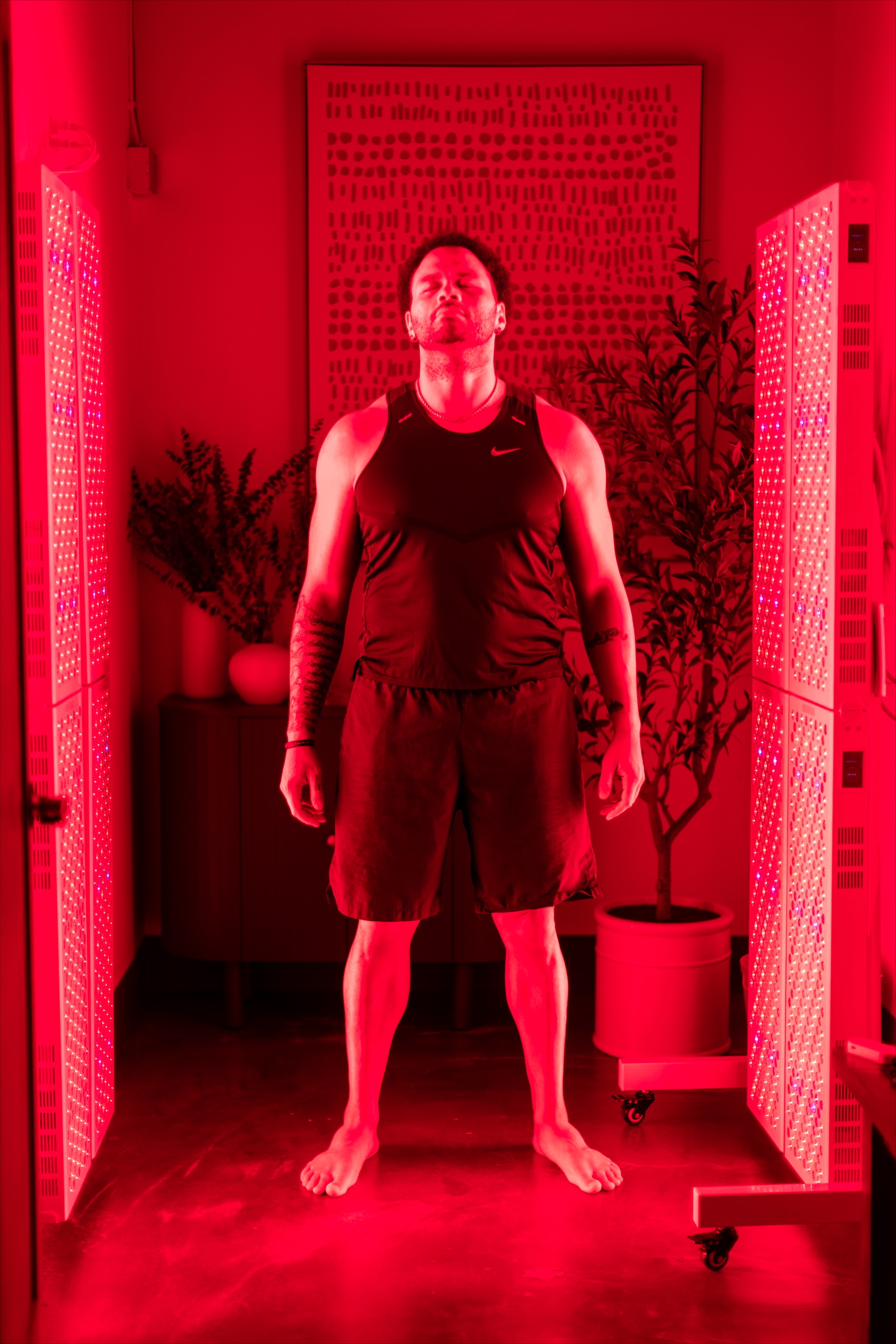
The Red Light Therapy panels we use at Lustre, contain a mix of R+/NIR+ spectral output, utilizing the blue light of 480nm wavelength, a blend of deep red light consisting of both 630nm and 660nm wavelengths alongside and optimized near-infrared blend of 810nm, 830nm, 850nm & 1060nm wavelengths
How Does Red Light Therapy Work?
The leading theory centers on the mitochondrion, the "powerhouse" of your cells. When specific wavelengths of light penetrate the skin, mitochondria may absorb them and produce more cellular energy. That extra energy may help cells repair themselves, stimulate collagen production, and reduce inflammation.
Different wavelengths reach different depths. Red light mostly works on the skin's surface layers, while near-infrared light penetrates deeper, toward muscle, joints, and hair follicles. That's why many devices combine both.
Using Red Light: Potential Benefits Backed by Science
Researchers have studied red light therapy for years, and studies indexed by the National Library of Medicine cover everything from skin health to pain relief. The evidence is stronger for some uses than others, and results vary by device and wavelength. Here are the potential benefits with the most research behind them.
Benefits of Red Light Therapy for Your Skin
- Fine lines and wrinkles: Some studies suggest red light therapy may stimulate collagen, which could soften the look of a wrinkle over time.
- Acne: Red light may help calm the inflammation linked to breakouts.
- Skin conditions: Early research is looking at its role in wound healing and certain inflammatory conditions.
- Skin rejuvenation: Users often report improved tone and texture after consistent use.
Benefits Beyond Skin Care
- Hair growth: Low-level laser and LED devices have been studied for hair regrowth, and a few are FDA-cleared for this purpose.
- Muscle recovery and joint discomfort: Near-infrared light is often used by athletes and is being studied for exactly that.
Results are typically modest and take weeks to show up. It's a slow-and-steady kind of treatment.
Red Light Therapy and Collagen
Collagen is the protein that keeps skin firm and plump, and we make less of it as we age. Red light therapy may encourage fibroblasts (the cells that make collagen) to get back to work. That's the main reason it's so popular for signs of aging like fine lines and sagging. Think of it as a nudge for your skin's own repair system, not a magic eraser.
What About Blue Light and Photodynamic Therapy?
Red light gets most of the attention, but blue light is also used in skin care, mainly to target the bacteria involved in acne. Some people use red and blue LED together.
Photodynamic therapy is a different thing entirely. It pairs light with a light-sensitizing medication and is performed by a professional, often for precancerous skin lesions. It's not the same as a wellness lamp or mask.
Is Red Light Therapy Safe?
For most people, red light therapy is considered low risk, and it doesn't use UV light, so it isn't linked to skin cancer the way tanning is. Still, keep a few things in mind:
- Eyes: Bright light sources can be uncomfortable or harmful, so use protection.
- Sensitive to light: If you take medications that make you photosensitive, or have a condition affected by light, check first.
- Skin cancer concerns: Red light therapy isn't a substitute for skin checks. See a doctor about any changing mole or spot.
- Pregnancy and medical conditions: Ask your doctor before starting.
Should You See a Dermatologist?
Talking to a dermatologist is smart if you have persistent acne, hair loss, or any skin condition you want to treat seriously. They can tell you whether red light therapy can help in your case, recommend in-office treatments, and rule out anything that needs medical attention, including pattern hair loss, which can be male or female and has several possible causes.
The Bottom Line
Red light therapy is a promising, low-risk option with real research behind some of its uses, especially for skin rejuvenation, acne, and hair growth. It isn't a miracle cure, and cheaper devices may not deliver the wavelengths or strength they promise. Set realistic expectations, stay consistent, and let your dermatologist weigh in if you have bigger concerns.
Red Light Therapy FAQs
What type of light does red light therapy use?
It uses visible red light (roughly 620-750 nm) and invisible near-infrared light. Both are wavelengths of light that don't include UV, so there's no tanning or sunburn risk. Many devices combine red and near-infrared light so they can reach both the skin's surface and deeper tissue.
What are the effects of red light on the skin?
The effects of red light are thought to come from cells absorbing light energy, which may boost collagen, calm inflammation, and support repair. Researchers call the broader process the effects of photobiomodulation. Results tend to be subtle and build gradually with consistent use.
Who can benefit from red light?
People interested in smoother-looking skin, acne support, or hair regrowth are the most common users. You may benefit from red light if you're dealing with fine lines, occasional breakouts, or thinning hair, but results may vary.
Does red light therapy help with hair loss?
Some studies suggest low-level light may help with male pattern hair loss and female pattern hair loss by stimulating hair follicles. Results vary, so check with a dermatologist to find out what's behind your hair loss.
How often should I use red light therapy?
Most people use it a few times a week at 20 minute per session. The use of red light should stay consistent, since a single session won't do much. If your skin gets irritated, scale back.
Can I use red light therapy with other skin care products?
Generally, yes. Apply treatments after your session, and keep skin clean and product-free during it. If you use retinoids or other active ingredients, ask your dermatologist about timing, especially if your skin gets irritated or sensitive to light.
Is red light therapy the same as a light treatment for mood or sleep?
Not exactly. Bright white light boxes used for seasonal mood support are a different light treatment than targeted low-level red devices aimed at skin, hair, or muscle recovery. They serve different purposes.
